
Missaukee Parole and Probation Compared
Both forms of supervision take place in the community, yet they begin in different ways. Parole is a conditional release from a Michigan prison sentence. The Michigan Parole Board makes the release decision, and the Michigan Department of Corrections supervises the person through its Field Operations Administration. The official MDOC parole and probation overview is the state entry point. Probation is imposed by a court. It may include a county jail term, but it does not mean the person served an MDOC prison sentence. Bond supervision is different again. A person released from Missaukee County Jail on bond is not on parole or probation unless another order says so.
The distinction controls the search path. An MDOC parolee or state-supervised probationer may appear in the Offender Tracking Information System, known as OTIS. A district probation case may instead require the 84th District Court record and its probation contact. The court order is the best source for the legal terms of probation. OTIS is the best public starting point for an MDOC status.
| Point | Parole | Probation |
|---|---|---|
| How it starts | Release from an MDOC prison sentence | Sentence or order entered by a court |
| Main authority | Michigan Parole Board and MDOC | Sentencing court and the assigned supervision unit |
| Best first record | OTIS status and DATE PAROLED | Court register, judgment, and probation order |
| How it ends | MDOC discharge or other lawful termination | Discharge or completion under the court order |
- Parole
- Community supervision after release from an MDOC prison sentence.
- Probation
- Court-ordered supervision that may occur with or without a county jail term.
- Discharge
- The end of the relevant corrections or supervision jurisdiction, not merely release from a building.
- Absconder
- A person whom the supervising agency alleges stopped reporting or otherwise left supervision without authority.
Verify Missaukee Post-Release Supervision
Start with identity and case type. A name alone can return the wrong person. Use an MDOC number when it is known, or compare the full name, age, physical descriptors, offense, and sentence information. OTIS permits a last name or offender number and offers added filters for first name, sex, race, age, status, and identifying marks. A person whose only custody was Missaukee County Jail may never appear there.
Use the following sequence to establish what the public records actually say:
- Decide whether the person served a county jail term, an MDOC prison term, or only received a court supervision order.
- For an MDOC case, search OTIS by MDOC number or name and select “All,” “Parolees,” “Probationers,” or “Discharged” when the first search is too narrow.
- Read the exact status. Compare LOCATION, DATE PAROLED, sentence rows, and any supervision dates rather than relying on the first result line.
- For local probation, search the 84th District or 28th Circuit case and obtain the judgment, probation order, or discharge order if the docket text is unclear.
- Contact the office that owns the record. Ask MDOC about parole or MDOC supervision and the court about its own probation order.
A direct Missaukee County release-record search can help identify what happened at the jail before supervision began. The full county search and record path is available on the Missaukee County released inmates page.
Missaukee Supervision Status in OTIS
OTIS status labels answer different questions. “Parole” generally means the person has left prison and is under community supervision. “Probation” reflects a circuit-court or county sentence supervised by MDOC; it does not prove a prison term. “Discharged” means the person is no longer under MDOC jurisdiction for that sentence. MDOC notes that discharge can result from completion, expiration at the maximum, or death, so the word should not be converted into a claim about how the person left custody.
DATE PAROLED is the most useful OTIS field for a past prison departure. A parole-board jurisdiction date is an eligibility or calculation marker, not the day the gate opened. Maximum date concerns the potential sentence endpoint. Status says what MDOC reports now. Read all four concepts together. OTIS also excludes jail-only sentences, people not yet sentenced, protected information, and some older discharged records. MDOC generally removes a discharged public record after three years off supervision, though a later supervision episode can restart that period.
For a record that does not appear, check spelling and search status before drawing a conclusion. A missing OTIS result cannot confirm that probation ended or that no state case existed.
Note: Record the exact status label and check date because supervision data and agency assignments can change.
Missaukee Parole and Probation Offices
Missaukee’s official court pages make an important local split clear. The regional Probation and Parole Office is in Cadillac and handles the state field-supervision channel. The 84th District Court identifies a separate local probation officer. Calling district probation about an MDOC parole case can delay the answer. Likewise, an MDOC field office cannot amend a District Court order.
Regional Probation and Parole Office
401 N. Lake Street
Cadillac, MI 49601
(231) 779-9494
Missaukee County contacts are also listed through the 28th Circuit Court at county extensions 217, 218, and 219. Staff assignments can change, so confirm the current agent or secretary before relying on a name.
84th District Court Probation
111 S. Canal Street
P.O. Box 800
Lake City, MI 49651
County extension 215
Use the official District Court route for a district probation matter. Obtain the case number and current order before asking about status.
The office that supervises a case is not always the office that created the sentence. Keep the court case number, MDOC number, and full name ready. Those details help staff distinguish namesakes and route a question to the right record owner.
Missaukee Community Corrections Supervision
Wexford-Missaukee Community Corrections adds a local layer that is separate from ordinary parole verification. Its official program page describes Public Act 511 funding and monitoring for specified bond cases in the joint circuit and district system. Missaukee’s 84th District uses a separate Total Court Services path. These program links explain who may monitor a participant, but they do not prove release from jail.
The local program lists random testing and electronic monitoring, including drug tests, alcohol tests, Soberlink, and GPS. It also states that Catholic Human Services provides an Enhanced Outpatient Program at no charge. Published costs are $20 for drug testing, $10 for alcohol testing, and $10 per day for either Soberlink or GPS. These are program charges, not jail release fees and not proof that a person is presently enrolled.
When a court record mentions community corrections, read the exact order. Bond monitoring, probation, and parole carry distinct legal authority. The joint program’s public explanation also contrasts a county jail sentence of less than one year with prison terms that have minimum and maximum components. Treat that as the local program’s explanation, then use the actual judgment and live agency record for the person.
Missaukee Supervision Violations and Absconders
Conditions are the rules attached to release or a court sentence. They can include reporting, travel limits, testing, treatment, fees, or electronic monitoring when ordered. A violation allegation does not itself prove a new crime. The supervising agency or court must use its process, and the public record may show a warrant, hearing, amended order, or other action.
OTIS distinguishes parole absconders and probation absconders. A parole absconder label means MDOC is seeking a parolee alleged to have stopped reporting or otherwise absconded. A probation absconder remains within the sentencing county’s jurisdiction. Neither label is a conviction. Missaukee County has no separate official online absconder list identified in the reviewed sources, so use the live OTIS entry or issuing court rather than an old copy.
The Michigan Sex Offender Registry is not a general supervision database. It applies only to people subject to registration law. Labels such as Active, Incarcerated, Absconder, or Homeless concern registry status and do not supply the Missaukee jail release time. Registry absence proves nothing about a person’s broader custody or supervision history.
Note: A warrant or absconder label reports an agency allegation and should be checked against the live issuing record.
Missaukee Parole Hearings and Release
The Michigan Parole Board conducts parole consideration for MDOC sentences. Routine review generally starts about six months before eligibility or reconsideration, and a Board member usually conducts an interview by secure video. This process does not produce a Missaukee-specific public calendar. The public-hearing registration page covers special public hearings, including certain lifer and clemency matters, not every routine parole interview.
A hearing notice is not a release decision. Outcomes can grant, deny, defer, continue an investigation, or alter a prior action under the governing process. Even a grant does not mean physical release has occurred. MDOC states that at least 28 days separate a Board release decision from physical release, while plans, processing, or new facts can intervene. Confirm DATE PAROLED and current OTIS status.
The official public-hearing index shows how MDOC posts notices and registration details.
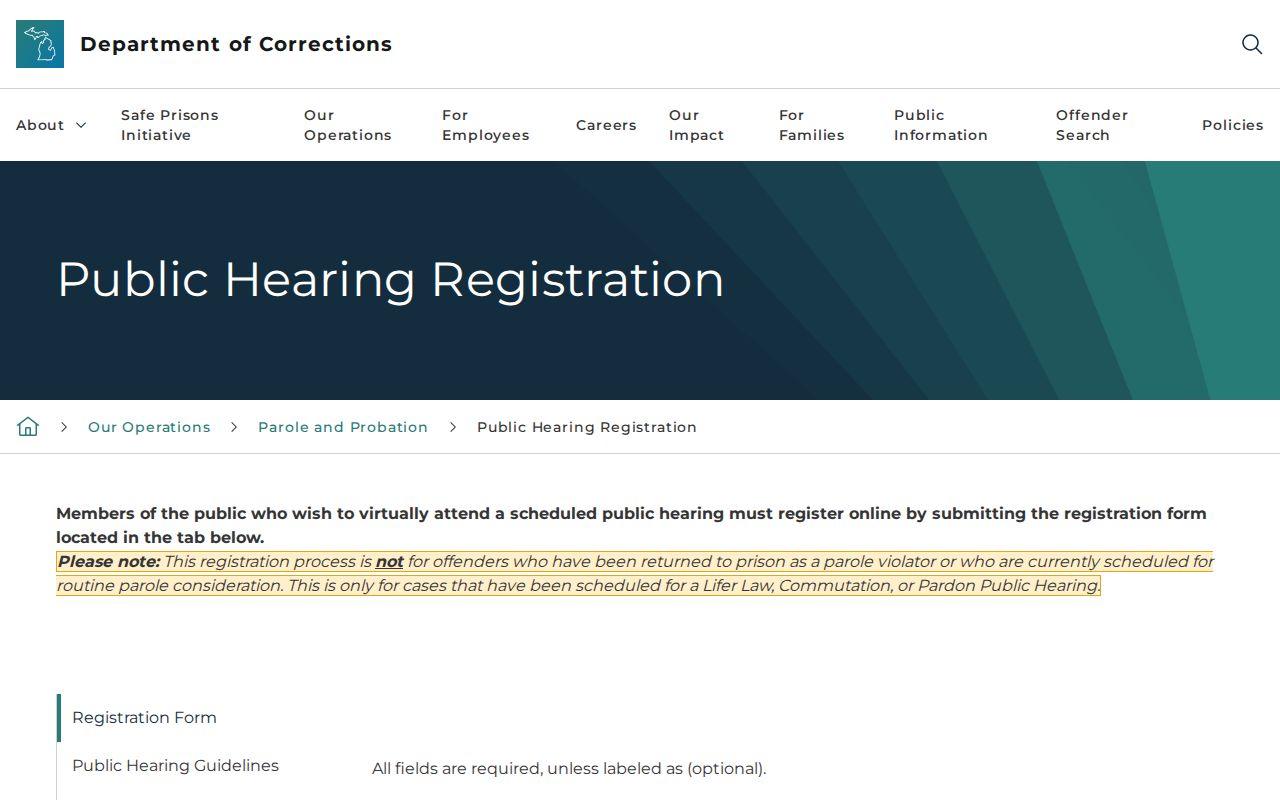
The image is useful for finding a public notice, but no listed event alone proves that a Missaukee County person received parole or left prison.
Correct Missaukee Supervision Records
An error should go to the office that owns the source fact. Court-derived conviction and sentence data should first be checked with the sentencing court. MDOC supervision, location, and absconder fields belong with the field office or MDOC. A Missaukee booking or local release time belongs with Sheriff Records. Sending a court amendment request to the Sheriff or asking MDOC to change a local bond order will not fix the originating record.
Missaukee Sheriff Records accepts supporting documents through its mail, fax, and email channels. Identify the exact booking and disputed field, then ask which unit can review it. If a court order caused the mismatch, obtain an amended or corrected order from the court. For an OTIS issue, compare the live record with the judgment before contacting MDOC. Keep copies of the material sent and the response.
Supervision ends through a formal event, such as discharge, sentence expiration, or a court order. Release from jail or prison is only the physical-custody step. The final discharge record, current OTIS status, or probation-discharge order is the sound basis for stating that supervision ended.
Note: A release date and a supervision discharge date answer different questions and should never be merged.