
Missaukee Projected and Actual Release
A projected or calculated date is a planning field. It reflects the sentence and rules known to the agency when the calculation was made. Actual release is the event recorded when a jail or prison relinquishes physical custody. Between those points, a court can amend a sentence, another agency can lodge a hold, or the Parole Board can act. Even a valid date can move.
The labels matter most in an MDOC case. “Parole Board Jurisdiction Date” describes an eligibility or calculation point. “DATE PAROLED” is the date MDOC says the offender left prison for parole. “MAXIMUM DATE” is the potential outside endpoint under the displayed sentence calculation. Current status shows whether MDOC describes the person as a prisoner, parolee, probationer, discharged person, or another category. These fields are related, but they are not interchangeable.
A pretrial Missaukee County Jail detainee is different. No sentence has fixed an endpoint. A bond order can permit release, but payment, processing, and any other hold still matter. The court docket can explain the authority. The jail’s completed release entry supplies the physical event.
Find a Missaukee Inmate Release Date
Choose the source by custody type. OTIS is for people under MDOC jurisdiction and a limited set of former MDOC prisoners. It does not reliably include someone whose full custody was a short stay at Missaukee County Jail. The local jail and sentencing court control that county calculation.
- Identify whether the matter is pretrial, a county jail sentence, or an MDOC prison sentence. Check the judgment if the custody type is unclear.
- For an MDOC case, open OTIS. Search by MDOC number when known, or combine the name with age, sex, race, and status filters.
- Select the correct person and read the full profile. Copy each date together with its exact label, current status, and sentence row.
- For a Missaukee jail sentence, obtain the judgment and jail-credit information from the court, then ask the jail which calculation governs the local release.
- For a person not yet sentenced, follow the court’s bond and hearing record. Do not create a date from the charge or an expected case outcome.
- Confirm any anticipated event with the holding office. After release, request the actual date, time, and release type from the record custodian.
The full county lookup path for a person whose custodian is uncertain appears on the Missaukee County released inmates search. That route separates a local jail event from an MDOC transfer, federal matter, or ICE custody question.
Note: A person missing from a current jail page may have been transferred and should not be assumed free.
Missaukee Release Fields in OTIS
OTIS requires either a last name or an offender number. A wildcard can follow at least three leading letters in the name interface, though that may create many namesakes. A known MDOC number is much safer. Filters can narrow by first name, age range, sex, race, status, and scars, marks, or tattoos.
The public search can include active offenders, prisoners, parolees, probationers, discharged records, and absconder categories. If an active-only search fails, deliberately select “All” or “Discharged.” OTIS excludes jail-only sentences and unsentenced people. It also states that a discharged record is generally removed after three years off supervision, subject to a later episode and other limits.
| OTIS field | What it can mean | What it does not prove |
|---|---|---|
| Current status | How MDOC classifies the person now | The exact local jail release time |
| DATE PAROLED | Date the person left prison on parole | Final discharge from MDOC |
| Parole Board Jurisdiction Date | Eligibility or calculation point for Board jurisdiction | A promised or completed release |
| MAXIMUM DATE | Potential sentence endpoint under the calculation | A scheduled prison gate date |
| Location | Institution or supervision-office context | A parolee’s home address |
The official OTIS overview presents the search scope and cautions captured in the matched research image.
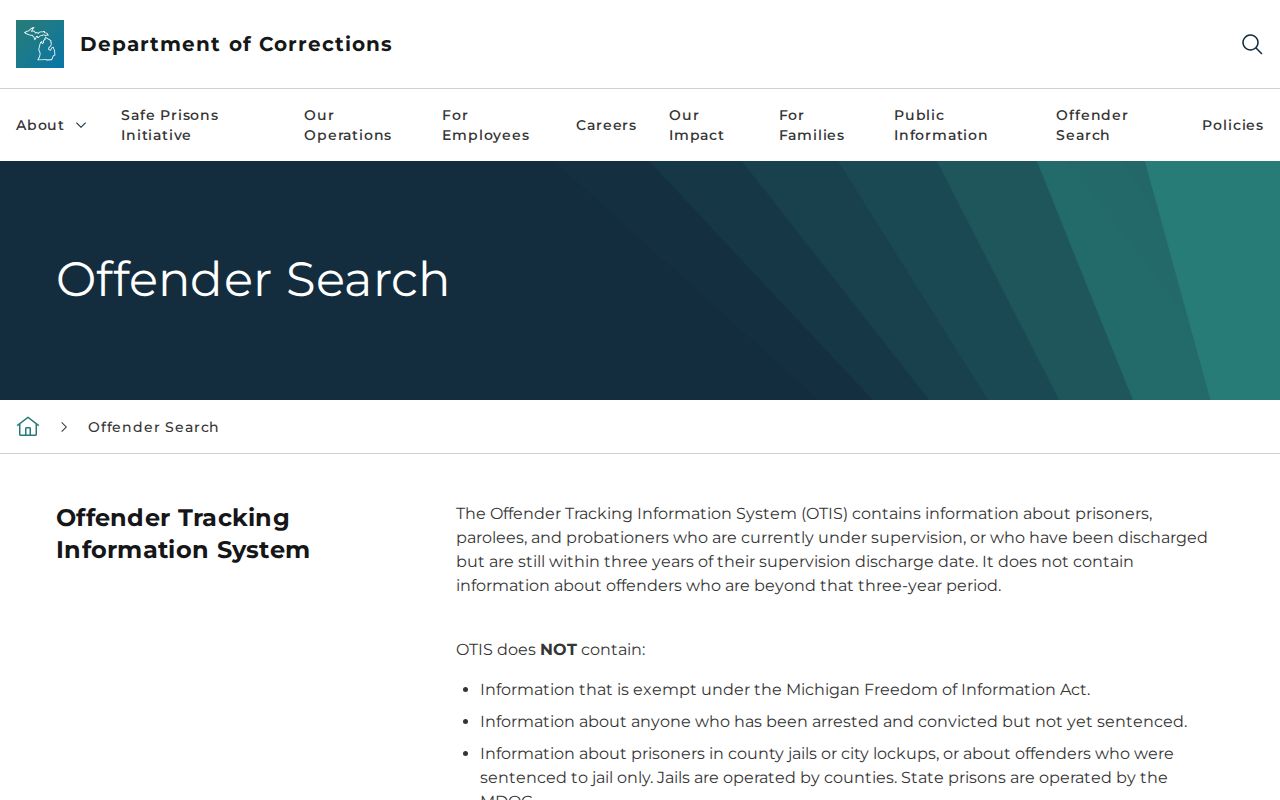
The search screen is the entry point, but the correct result’s status, sentence, and date labels supply the useful context.
Michigan Rules for Missaukee Release Dates
Michigan uses indeterminate prison sentences. In broad terms, a judicial minimum helps define when parole consideration can begin, while a statutory maximum sets an outside framework. Parole eligibility is not a right to release. The Michigan Parole Board must act, and sentence-specific restrictions still apply.
MCL 791.233 bars parole before applicable minimum-term conditions are met and addresses disciplinary-time sentences. MCL 791.234 governs Board jurisdiction, consecutive minimum terms, life-sentence rules, and special categories. Offense type, offense date, minimum term, sentence structure, and exclusions all matter. Some life terms use different calendar thresholds based on the crime date, while expressly nonparolable sentences are treated differently.
MCL 791.235 reinforces that parole begins through Board action, not merely because a date arrives. A jurisdiction date, interview, hearing notice, or guideline score is not confirmation of release. Once the Board grants parole, MDOC sends the matter through release processing. MDOC says at least 28 days separate the decision from physical release, and plans or new developments can still intervene.
This structure is why no percentage calculator belongs in a Missaukee County release-date lookup. Michigan law does not create a universal rule that every prisoner serves 85 percent. A live OTIS record and the governing sentence documents are safer than an arithmetic estimate.
Missaukee Good-Time Date Limits
Credit treatment depends heavily on the offense date and governing sentence. MCL 800.33 preserves older good-time schedules and credit rules for covered groups, including a pre-April 1987 structure. It also states that disciplinary-time prisoners are not eligible for good time, special good time, disciplinary credits, or special disciplinary credits under that framework.
MCL 800.34 addresses disciplinary time for major misconduct and identifies controlling dates, including designated serious crimes beginning in 1998 and other crimes beginning in 2000. Michigan truth-in-sentencing changes removed the old credit reduction of the judicial minimum for many modern offenses. Covered prisoners must serve that minimum before parole eligibility, subject to the exact law and sentence. Older cases and specially governed categories can differ.
Good-time note: Use the live sentence and offense date with MCL 800.33 and 800.34. Do not import an old credit rule into a modern sentence.
A county jail calculation is separate. For a Missaukee term of less than one year, use the judgment, actual commitment date, jail credit, consecutive or concurrent terms, local lawful credit, holds, and any amended order. MDOC’s prison calculation should not be copied onto a county sentence. Ask the court and jail for the calculation they use.
Why Missaukee Release Dates Change
A date can change for both legal and factual reasons. Some changes adjust the sentence itself. Others stop a planned community release because another custodian has authority. The proper response is to identify the factor, then confirm it with the office that owns that part of the record.
| Factor | Possible effect | Best source |
|---|---|---|
| Sentence correction | Changes the minimum, maximum, or credit calculation | Sentencing court and corrected judgment |
| Added case or hold | Prevents community release or transfers custody | Jail, court, and receiving agency |
| Credit recalculation | Moves an eligible sentence date | Holding agency’s sentence computation |
| Misconduct consequence | Affects credits or release processing where law permits | MDOC record and governing statute |
| Parole Board action | Grants, denies, defers, rescinds, or modifies action | Board record and live OTIS status |
| Transfer or detainer | Ends custody at one facility without freeing the person | Release disposition and receiving custodian |
| Medical or executive action | Changes the ordinary release path in a specific case | Official order and agency record |
A local jail “release” marked transfer only shows that Missaukee County Jail relinquished custody. OTIS may later show an MDOC commitment after intake posts. Federal or immigration custody requires the respective agency channel. A missing name on the county’s current-information page cannot resolve any of those possibilities.
Missaukee Jail Sentence Calculations
The 84th District Court and 28th Circuit Court records can show bond action, sentence terms, jail credit, probation, and amendments. A docket line is useful, but the signed judgment or order is stronger. The jail holds the operational calculation and the eventual release entry. Compare both sources when a projected county date matters.
For a pretrial person, follow the next hearing and current bond order instead of seeking a sentence endpoint. Posting bond does not itself prove the door opened. Processing must finish, and another warrant or detainer may prevent release. For a sentenced person, ask whether terms are concurrent, served at the same time, or consecutive, served one after another. Confirm the jail-credit figure and any later order.
A Missaukee County court record may persist after the jail’s current information no longer shows the person. The MiCOURT Case Search covers participating courts, while the local court pages route users to the appropriate Missaukee record. A court order can explain why release was authorized. Only the jail record states the actual physical release date and time.
Note: County jail credit and MDOC prison credits arise under different records and should not be blended.
Confirm Missaukee Actual Release Dates
After an anticipated date passes, check the status again. For an MDOC prisoner, compare DATE PAROLED and the new status in OTIS. A parole status means release from prison to supervision, not final discharge. For Missaukee County Jail, use the official jail contact route for immediate status and request the existing release record from Sheriff Records when documentary proof is needed.
Michigan VINE can add a person-specific alert while the individual remains represented in a participating agency stream. It is not a certified record, and data can lag. Registration and verification steps are covered in the VINELink Release Check. A received notice should still be checked with the named jail or MDOC.
The MDOC release-date guidance in the matched research image comes from the official corrections FAQ source.
The official guidance supports using MDOC’s own calculations and live status instead of predicting a date from a sentence percentage.
If the date appears wrong, send the issue to the source owner. A court sentence error starts with the court. An MDOC calculation or status issue belongs with MDOC. A Missaukee jail release time belongs with Sheriff Records. Include the person’s full name, case or MDOC number, disputed label, and supporting order.